Your Hotel Is Paying for Shortcuts You Forgot You Took
There is a persistent issue I see when auditing hotels or working with properties going through renovations and repositioning. A hotel approaches us to help them define or redefine their brand, to look through where the gaps are and where what they’re doing is working. They’re too in the weeds, and they can’t ‘read the label on the jar from the inside’.
What I find is 4 different approaches taken on 4 (if not more) different touchpoints. The brand expression across guest-facing assets is completely disjointed, you could place these assets side by side and come to the conclusion that they belong to 4 different hotels.
If you’ve worked long enough in hospitality, you’ve experienced this too - maybe even at your property. The menu redesigned in a rush before the season kicks off, the outdated deck still going out to sales teams, or the confirmation email with your old logo and generic copywriting.
Each quick shortcut may have been the right call at the time, but together such decisions compound into a larger snowball each time a guest experiences them.
Quick Shortcut Lead to Painful Fixes
When software developers fall behind, they ship the messy version of their code, knowing they will have to come back to fix it later. They call that gap Technical Debt.
Hotels borrow from the future in the same way. Hotel Brand Debt is what you owe for every decision made for speed instead of strategy. And like any debt, it charges interest: every new asset you build on an shaky brand foundation adds to what you will eventually have to repay - whether through the cost of a redesign or in the cost of broken guest trust and degraded experience.
One more layer is worth mentioning: some Debt is deliberate and intentional, you cut the corner on purpose, you know exactly what you cut, and you plan to come back to it. The worse type of Debt is accidental, there was no clear direction on what you wanted to achieve - so assets were delivered quickly and based entirely on individual team members personal preference (and sometimes lack of clarity). Deliberate Debt is manageable, Accidental Debt grows in the shadows, and the latter is what most hotels are compounding.
How Hotels Take On the Debt
Hotel brand debt forms across every stage of a hotel’s life. I’ve organized the borrowing by phase, and then by the size of the operation, because the solution looks different in each case.
Pre-opening, the debt looks like:
Concept, positioning, differentiation, and guest psychographics are never given the time to be properly defined and communicated to stakeholders
Brand voice, messaging, and point of view are left vague (’luxury’, ‘leisure’, ‘business travel’, ‘authentic’)
No brand guidelines or standards exist, so “on-brand” means whatever the loudest voice in the room says it means
Deadlines that make strategy impossible (”we’re opening in a month,” “we wanted it yesterday”)
Design by committee: an uncoordinated team where every opinion carries equal weight regardless of qualification
Post-opening, the borrowing continues:
New stakeholders begin speaking on behalf of the brand and without clear standards to follow, dilute the original strategy and voice
Quantity of touchpoints gets prioritized over consistency and quality of touchpoints
Short-term fixes replace aligned execution
No recurring brand audits to check standards across print and digital
In newly launched, smaller boutique hotels, the debt has two common sources, and they deserve separating.
The first: owners take on creative decision-making themselves, or delegate it to junior staff who aren’t equipped to define a vision or execute it through copywriting, visual design, and web. The result is an amateur outward expression of the brand — lower perceived value, difficulty attracting the intended guest, lost momentum.
The second is more subtle. Even when the brand is built correctly from the start — by a studio or an experienced internal team — owners tend to stay in the approval chain for every output. A noble instinct, and an expensive one. Every hour spent reviewing a social post is an hour pulled from the place where an owner’s judgment actually makes a big difference: operations and the guest experience. The brand gains an ‘approver’ and layer of beaurocracy it never needed, and service quality suffers because of it.
In growing or established brands, the operation gets more complex and new stakeholders arrive, hired precisely to give input. But without clearly communicated brand standards, that input dilutes the positioning it was meant to execute on. A hotel that built a powerful identity can be led astray in a few quarters of committee decisions, each one reasonable in isolation, but together producing a Frankenstein outward appearance no one agrees on.
The Interest Hotels are Paying
The most significant consequence of Hotel Brand Debt is guests price and make a judgement about your property through your weakest touchpoint.
A potential guest who views a well-produced lifestyle Instagram reel but visits your website and it looks like it was made in 2009 will automatically lose trust with the hotel. They may think (subconsciously, at a gut level) “that reel was just a facade, it doesn’t seem like they care that much”, “how can they have such a lovely video but such a poor website?”, “something doesn’t feel right”.
A guest choosing between your hotel and four others is asking one question, usually without knowing they’re asking it: is this a place for someone like me? They answer it by reading every signal you send. When those signals contradict each other, the guest can’t complete the picture.
Then the interest mechanics take over, every new asset created on a broken foundation adds to the Debt. Ten menus printed off-brand cost ten times more to fix than one - I’m not referring to simple monetary costs and paying a studio or the paper cost, but in loss of trust from the guest, which is arguably much more detrimental to your hotel.
With Brand Debt, your team loses the ability to tell on-brand from off-brand, so every decision becomes a debate and a subjective individual decision. Your positioning turns messy, the website design system speaks one language, the tone of voice another, your social a third, and your sales material a fourth. This can go on endlessly.
Guests who arrive on the strength of one touchpoint meet a property that contradicts it, and the trust that produces a first (or second) booking never takes hold.
Checking Your Debt
I don’t want to overcomplicate things, but provide an actionable framework to do this. The audit takes an afternoon or two with your team. If you want a more comprehensive approach, reach out.
Pull a wide sample of collateral: print (menus, stationery, signage, uniforms, guest notes) and digital (website, social, email flows, OTA listings, sales decks) and look at it with a clear eye. The inconsistencies will be visible fast: one font on social, another on the website. Pre-renovation photography still running in ads. A B2B events deck that showcases your (now closed) restaurant floorplans.
If you have a clear brand direction and an aligned team, the off-brand assets stick out immediately. Hand them to your internal team or studio, and approve no reprints until every asset feels like part of one unified journey.
If you don’t have a clear brand direction, the audit gets harder. There is no filter for what’s “right,” so every judgment collapses into the personal taste of whoever is most senior in the room. In that case, appoint a agreed upon ‘brand reference’: the single strongest asset you own, one that sits closest to the property’s original opening intent or future market positioning. You can them make adjustments to your current assets with that reference in mind. This process will provide enough time and just enough brand consistency to then meet with your team or studio to clarify what the hotel stands for. Do not leave things as they are. Every month you wait the balance grows.
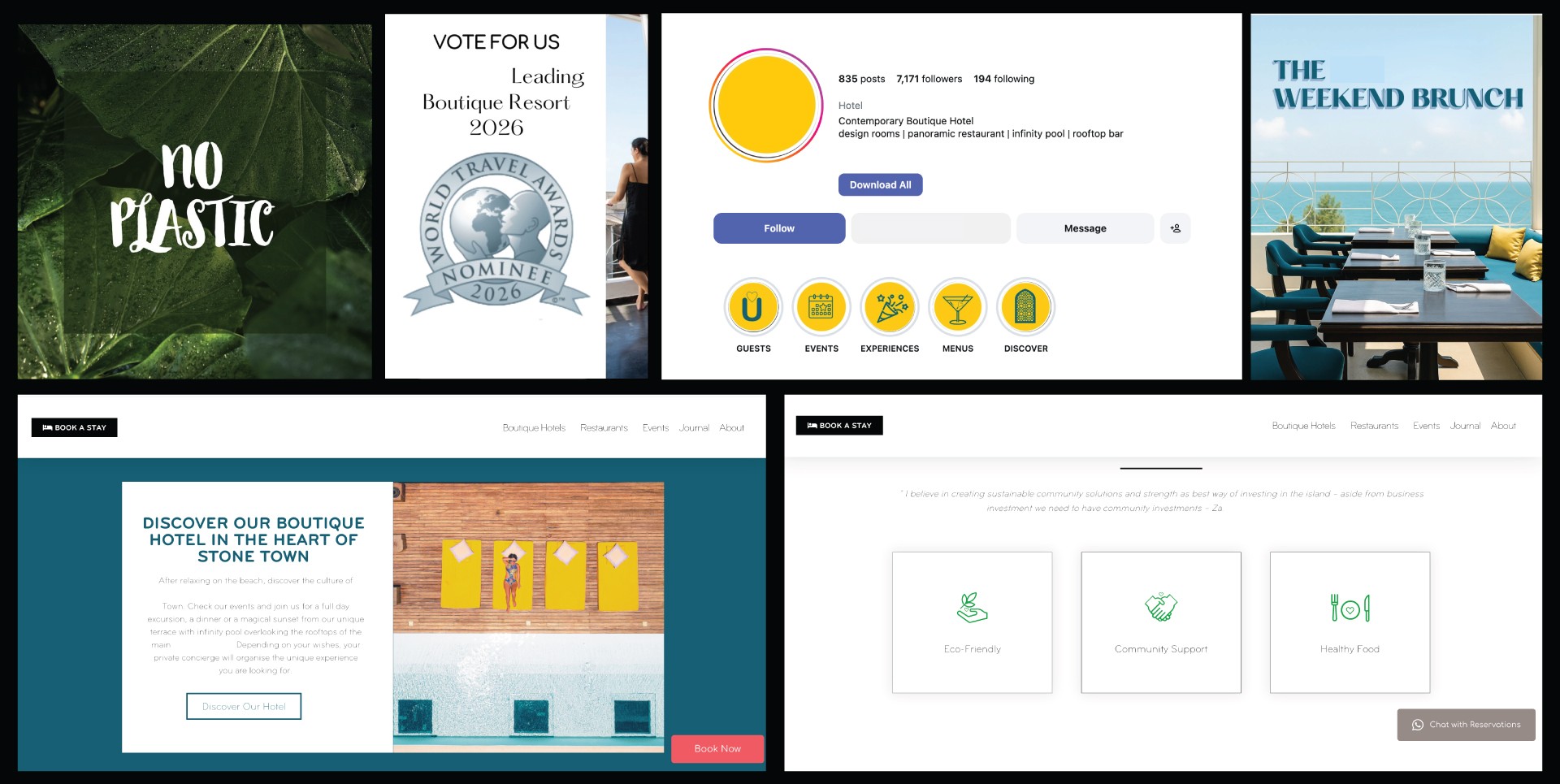
Above: An example of a boutique property whose assets are presenting differently. Big variations in color usage, font usage, and overall visual direction (name and location blurred for confidentiality).